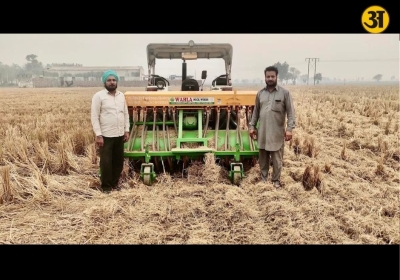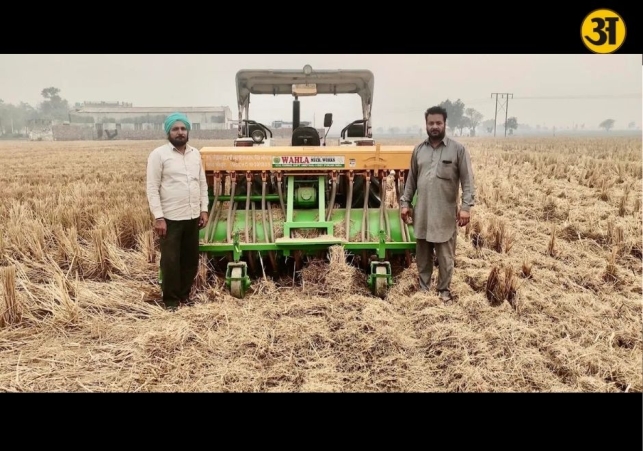
Many stubble management machines lie unused in Punjab
Nearly one-fourth of crop residue machines in Punjab now non-functional, state tells CAQM
- By Gurmehar --
- Friday, 30 Jan, 2026
Nearly 25 percent of the crop residue management machines provided to farmers in Punjab over the past six years are no longer functional, the state government has informed the Commission for Air Quality Management. The disclosure has raised serious questions about the effectiveness of the multi-crore subsidy programme launched to curb stubble burning and reduce air pollution in north India.
According to official data shared by the Punjab government in an action plan submitted to the CAQM on January 28, close to 40,000 out of 1.58 lakh machines distributed since 2018 are now redundant. These machines were supplied under the centrally sponsored in-situ crop residue management scheme, which was designed to help farmers manage paddy straw without burning it in fields.
Crop residue management machines such as Happy Seeders, Super Seeders, and balers are tractor-mounted tools that allow farmers to sow wheat directly into fields covered with paddy residue. By doing so, they help prevent open burning of straw, which is a major source of air pollution during October and November. Smoke from farm fires in Punjab and Haryana contributes significantly to severe smog in the National Capital Region every winter.
Machines turning obsolete and missing
Punjab’s agriculture director Jaswant Singh explained that the average lifespan of these machines is around five years, which means many of the earlier models are now worn out or outdated. He also pointed out that rapid technological upgrades have made older machines less useful. For example, the Happy Seeder, which was widely promoted in 2018 and 2019, has since been replaced by the Smart Seeder, and later by the Super Seeder.
This fast pace of change has meant that farmers who received older machines often stopped using them once newer and more efficient options became available. In some cases, machines broke down and were not repaired due to high maintenance costs or lack of spare parts.
The problem of redundancy has been compounded by issues of missing equipment. In 2022, the state found that around 11,000 machines were unaccounted for out of nearly 90,000 distributed till that time. The estimated financial loss was around ₹140 crore. Following this, the agriculture department ordered a vigilance bureau inquiry after investigations by the Enforcement Directorate.
ALSO READ: Trump warns Iran next attack will be far worse if no nuclear deal is reached
ALSO READ: Netanyahu’s taped phone camera sparks online debate over digital safety
However, the inquiry did not lead to strong conclusions. During physical verification, several farmers admitted that the machines had either been sold, transferred, or moved elsewhere. Tracking them became difficult, exposing gaps in monitoring and accountability within the subsidy programme.
Despite these challenges, Punjab has continued to spend heavily on crop residue management. Since 2018, a total subsidy outlay of about ₹2,229 crore has been made to promote alternatives to stubble burning. Between 2018 and 2022, the entire funding came from the Centre. After that, the cost-sharing pattern changed to 60 percent Centre funding and 40 percent state funding.
Impact on stubble burning and future plans
Even with large investments, Punjab has struggled to completely eliminate stubble burning, a key requirement set by the CAQM. While there has been a noticeable decline in the number of farm fire incidents, the problem remains serious.
During the 2025 kharif season, Punjab reported 5,114 stubble burning cases, nearly half of the 10,909 cases recorded in 2024. However, the numbers were much higher in earlier years, with 36,663 cases in 2023 and 49,922 cases in 2022. These figures show that while progress has been made, the pace of improvement is uneven and fragile.
Every year, paddy is grown on nearly 30 lakh hectares of land in Punjab, producing around 190 lakh tonnes of straw. Farmers often burn this residue because the window between paddy harvesting and wheat sowing is very short. Burning is the quickest and cheapest way to clear fields, even though it causes serious health and environmental damage.
Looking ahead, the Punjab government has proposed a new action plan worth ₹500 crore for the upcoming kharif season to manage paddy stubble during October and November. The plan, prepared by the state’s department of science and technology, includes providing 15,000 additional machines and agricultural implements to farmers.
Chief secretary KAP Sinha is expected to review the proposal soon, and the state may approach the Centre for additional funds. Officials say the focus this year will be on eight hotspot districts where stubble burning remains high. These include Tarn Taran, Sangrur, Ferozepur, Muktsar, Bathinda, Moga, Mansa, and Faridkot.
Jaswant Singh said special attention will be given to villages that repeatedly resort to burning paddy straw. The government plans to combine machine support with stricter monitoring, awareness campaigns, and enforcement measures.
The latest disclosure to the CAQM highlights a key lesson from Punjab’s experience: providing machines alone is not enough. Long-term success in reducing stubble burning will depend on proper maintenance, better tracking of subsidised equipment, timely upgrades, and making alternatives truly affordable and practical for farmers.
Related News